Written by: Daniel Koren, Co-Founder, Frameology
Key takeaways
-
Modern gallery walls feel right when the center sits at 57 inches, frames are 2–3 inches apart, and visual weight feels balanced.
-
Seven proven layouts, from 3×3 grids and symmetrical pairs to staircase cascades, fit real homes in 2026 with exact dimensions and frame counts.
-
Common mistakes like hanging too high, uneven spacing, or the wrong scale above furniture are avoided by measuring first and keeping consistent 2–3 inch gaps.
-
Classic and Luxe gallery walls include life-size templates that remove measuring and unnecessary holes, so installation becomes a simple tape-hammer-hang process.
-
Ready-to-hang gallery walls with templates make the entire process effortless, so explore Frameology’s template-equipped collections to bring your layout to life.
The three rules every modern gallery wall follows
Interior designers and galleries follow a shared standard:
-
Position your gallery wall at eye level. Be sure to center the middle of your arrangement at 57–60 inches from the floor, which matches average human eye level. Treat the entire collection as one unified piece of art, then center that grouping at 57 inches. Hanging higher is one of the most common mistakes, and it makes every room feel slightly off.
-
Consistent spacing between frames. Space individual frames 2–3 inches apart to keep the composition cohesive. Larger gaps make a grouping look scattered, while tighter gaps under an inch feel cramped. Two to three inches hits the sweet spot that looks intentional from across the room.
-
Consider visual weight balance. Mix frame sizes so no single corner feels heavy. When you place a gallery wall above furniture, make sure the overall grouping spans at least one-half to two-thirds of the furniture’s width. A narrow cluster above a wide sofa looks like an afterthought.
Seven modern gallery wall layouts
With those three rules in place, you can use Seven specific layouts with dimensions, frame counts, and installation notes that work in real homes in 2026.
1. 3×3 grid gallery wall
The 3×3 grid layout uses equal-sized frames in a mathematically perfect grid, which creates a modern, minimalist look. A standard setup uses nine frames with 2-inch spacing between each. That size works well in living rooms, home offices, and hallways.
Grid layouts work especially well on walls with strong architectural lines, and the repetition keeps your eye moving comfortably across the wall. Even small measuring errors show in a grid, so precision matters more here than in any other layout. A life-size gallery wall template removes that risk completely.
Frameology’s Classic Grid II, Classic Grid III, and Luxe Vertical Grid follow the 3×3 grid gallery wall format with gallery wall templates included. Bobby Berk described the Luxe Vertical Grid as “like an Instagram feed for your wall… the fact that it comes with a template for hanging makes it so much easier than trying to do this on your own.”
2. Symmetrical gallery wall ideas
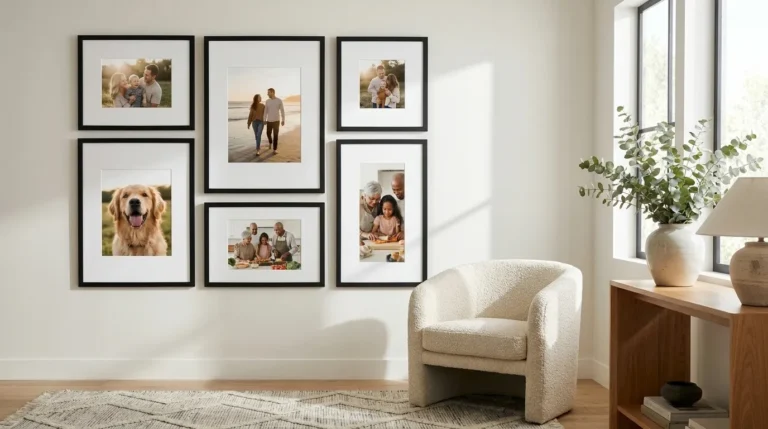
Symmetrical arrangements use mirrored pairs or balanced columns to create a formal, composed look. A classic version pairs two identical frames on either side of a center point, such as two 16×20 frames hung side by side with a 2-inch gap, centered at 57 inches. A more elaborate version stacks two columns of three matching frames, with each column 3 inches apart and 2-inch spacing between rows.
Structured grid or rectangular layouts are easiest when all frame sizes match, so symmetrical arrangements work well for anyone who wants a clean result without a lot of design decisions. They shine in dining rooms, where a centered, formal composition looks especially polished from a seated viewing angle. Frameology’s Classic Offset and Luxe Diptych are two symmetrical ready-to-hang options worth considering for paired and balanced layouts.
3. Asymmetrical gallery wall
The asymmetric cluster arranges five to seven different-sized frames around an invisible center point, anchored by one large piece that makes up about 40% of the total display width. Start with the anchor piece slightly off-center. Build outward with the next-largest frames first, then fill gaps with smaller pieces. Keep 2–3 inches of spacing throughout.
This layout works best on walls with at least 6 feet of horizontal space. It suits living rooms and dining rooms where you want a relaxed, collected-over-time feel. The more irregular the layout, the more you need visual cohesion through a shared color palette, consistent frame finish, or common theme.
Frameology’s Classic Hallway, Classic Hallway II, and Luxe Hallway are ready-to-hang asymmetrical options that each include a gallery wall template for straightforward installation.
4. Picture ledge gallery wall
The ledge display uses floating picture ledges so frames can lean at different depths and layers, with room for small decorative objects. This setup lets you rearrange seasonally without adding new nail holes. Install one ledge at 57 inches for the primary display, then add a second ledge 12–14 inches below for a layered look.
This format is one of the most renter-friendly gallery wall options because the ledges need only a few anchor points, and the frames themselves skip individual nails. Swapping photos or rearranging the layout takes just a few minutes. It also pairs naturally with the Classic Table, which has a removable backing for easy photo swaps.
5. Horizontal row layout
The horizontal row layout places several frames straight line with centers aligned at the same height, keeping all frames the same height while varying widths slightly. This approach works best above a sofa, bench, or credenza. Position the bottom of the frames 4–8 inches above the furniture surface, and center the row at 57 inches.
Horizontal linear layouts emphasize width and can make a room feel larger, which makes them especially effective in living rooms and hallways. A three-frame row of 8×10 frames with 2-inch spacing spans roughly 34 inches, which fits comfortably above most sofas. Frameology’s Classic Wide and Classic Wide II are both designed for this kind of horizontal run, with gallery wall templates included.
6. Staircase cascade layout
The staircase cascade layout follows the diagonal angle of a staircase using 5–8 pieces in consistent frames, with equal diagonal spacing measured center-to-center rather than edge-to-edge. A standard approach spaces frame centers 6–8 inches apart diagonally, stepping each frame up by the same increment to follow the stair pitch.
Vertical linear layouts draw the eye upward and can make ceilings feel higher, which suits a staircase wall perfectly. Frameology offers four staircase options: Classic Staircase, Classic Staircase II, Classic Staircase III, and Luxe Staircase.
7. Triptych statement layout
The Triptych layout splits one continuous image across three panels with 1–2 inch gaps between panels to create a panoramic effect. This layout works best above beds, sofas, or dining tables. The narrow gap is intentional, since it keeps the illusion of a single image while adding visual structure. Frameology’s Classic Triptych and Luxe Triptych both arrive ready to hang with gallery wall templates included.
Browse Frameology’s complete gallery wall collection to find your perfect layout.
Gallery wall mistakes to avoid
Most gallery wall problems come from a few recurring errors. Watch for these before you pick up a hammer.
-
Hanging too high: Relying on personal eye level instead of measuring from the floor leads to pieces hung too high for most viewers. Measure from the floor to the 57-inch mark every time.
-
Uneven spacing: Use a cardboard spacer cut to 2–3 inches to maintain the consistent gaps that keep a composition cohesive.
-
Skipping the layout test: Using painter’s tape to outline frame positions on the wall, or having someone hold pieces in place for a test photo before drilling, prevents misalignment and unnecessary holes. A life-size gallery wall template handles this step for you.
-
Wrong scale above furniture: A narrow cluster above a wide sofa reads as an afterthought. Aim for the proportions outlined earlier to keep the wall and furniture in visual balance.
-
Ignoring the room’s architecture: In rooms with a chair rail, position a gallery wall 2–3 inches above the rail instead of following standard furniture clearance rules.
How Classic and Luxe gallery walls make installation effortless
Frameology’s Classic and Luxe gallery walls focus on one core insight: the hardest part of a gallery wall usually isn’t choosing the photos, it’s the installation. Both lines include a custom, life-size gallery wall template that removes the measuring, the test holes, and the guesswork. One important note: Canvas gallery walls and gallery walls created through Frameology’s Gallery Wall Design Service don’t include a gallery wall template.
Here’s how the two lines differ:
-
Classic gallery walls (starting at $198) use flexible Classic frames, each hung from a single center point. Tape the template to the wall, hammer nails into the marked spots, remove the template, then hang your frames. The entire process usually takes less than an hour. Classic frames are hand-framed in the United States and feature a removable backing, so you can swap photos whenever you want. Classic frames ship quickly and typically arrive within a week.
-
Luxe gallery walls (starting at $638) use top-of-the-line, museum-quality frames that are 100% made in the United States from premium solid wood and metal moldings, acid-free mats, and UV-protecting museum-grade acrylic. Each Luxe frame hangs from two side points for perfect leveling and strong stability, and all hanging hardware, including nails and a mini-level, comes in the box. The Luxe gallery wall template accounts for the dual-point hanging system with slightly different instructions than the Classic template. Luxe gallery walls deliver in 7–10 business days.
Frameology has earned over 7,300+ verified 5-star reviews and a 4.98/5 overall rating, and the gallery wall system plays a big role in that feedback. You can learn more about why Frameology is the best online framing service.
Plan with Frameology’s mobile-only AR preview tool
Before you order, Frameology’s augmented reality (AR) preview tool lets you see exactly how a gallery wall will look on your actual wall. AR stands for augmented reality. The AR preview works on mobile only and supports both individual frames and gallery wall layouts.
Open the Frameology website on your phone, choose your layout, then tap the AR icon. Your phone’s camera projects a true-to-scale preview of the exact arrangement directly onto your wall, with no app download, no login, and no guessing. The AR tool allows for easy visualization in just 10 minutes, so you can confirm the layout fits your wall before you place an order.
Start your gallery wall project at Frameology today.
Frequently asked questions
How do I choose the right layout for my wall?
Begin with your wall’s dimensions and the furniture below it. For walls above a sofa or credenza, a horizontal row or wide asymmetrical layout usually works best, so aim for a grouping that spans at least half the furniture’s width. For staircase walls, a cascade layout that follows the diagonal pitch fits naturally.
For large, open walls, a 3×3 grid or salon-style arrangement creates the most visual impact. If you feel unsure, Frameology’s mobile-only AR preview tool lets you project a true-to-scale version of any layout onto your actual wall before ordering, so you can see exactly how it’ll look.
Do all gallery walls include hanging templates?
Classic and Luxe gallery walls include life-size gallery wall templates that make installation simple and straightforward. Canvas galleries, Metal galleries, and gallery walls created using Frameology’s Gallery Wall Design Service don’t include templates because their construction and customization work differently and often need more tailored installation approaches.
How long does each line take to arrive?
Classic gallery walls typically ship the next business day and arrive within a week. Luxe gallery walls are 100% made in the United States using top-of-the-line, museum-quality materials and take 7–10 business days because of their artisan craftsmanship. Both lines are worth planning a few days ahead of any room reveal or occasion.
Can I swap photos in a gallery wall frame later?
Classic frames feature a removable backing, so you can swap photos as often as you like, which works well for seasonal refreshes or new memories. Luxe frames feature a sealed, permanent kraft paper backing designed to protect your photo long term, so photos can’t be swapped once framed. If you want the flexibility to update your display over time, Classic is the right choice.
The simplest path from inspiration to finished wall
Modern gallery wall layouts work beautifully when three things stay consistent: the center of the arrangement sits at 57 inches, frames are spaced 2–3 inches apart, and visual weight feels balanced across the composition. From there, the layout becomes a matter of personal preference, such as a grid for precision, an asymmetrical cluster for personality, a staircase run for vertical drama, or a triptych for a panoramic statement.
The part that used to derail even the most motivated decorators, like the measuring, the test holes, and the leveling, is exactly what Frameology’s Classic and Luxe gallery walls solve with their included life-size gallery wall templates. Tape, hammer, hang. Classic finishes in under an hour, and Luxe delivers museum-quality results.