Written by: Daniel Koren, Co-Founder, Frameology
Key takeaways
-
Local custom framing has often been expensive and slow, with many projects costing $400–$800 and taking weeks, so countless photos stayed on phones.
-
Online framing services now provide faster turnaround, clear pricing, and tools like AR previews that make framing feel simple and approachable.
-
Helpful evaluation criteria include archival materials, ease of ordering, visualization tools, installation support, and clear turnaround expectations.
-
Frameology stands out with its Classic and Luxe lines, ranging from quick-ship value frames to museum-quality, USA-crafted pieces with all hardware included.
-
Ready to turn your favorite photos into gallery-worthy displays? Explore Frameology’s framing and gallery wall options at Frameology.
How custom framing moved from local shops to online services
The U.S. picture frame market was valued at $2.22 billion in 2025 and is projected to reach $2.37 billion in 2026, driven by homeownership, renovation cycles, and a fast-growing e-commerce ecosystem. The online segment is expected to grow at a compound annual growth rate (CAGR) of 9.10% through 2034, supported by smartphone use and the ease of browsing, comparing, and ordering from home.
Social media now shapes how people think about framed art and photos. Platforms like Instagram and Pinterest inspire curated wall galleries, minimalist layouts, and themed photo displays, which encourages people to recreate those looks at home. The personal photos segment alone is projected to grow at a CAGR of 5.65% through 2034, showing how strong the emotional pull of displaying family memories remains.
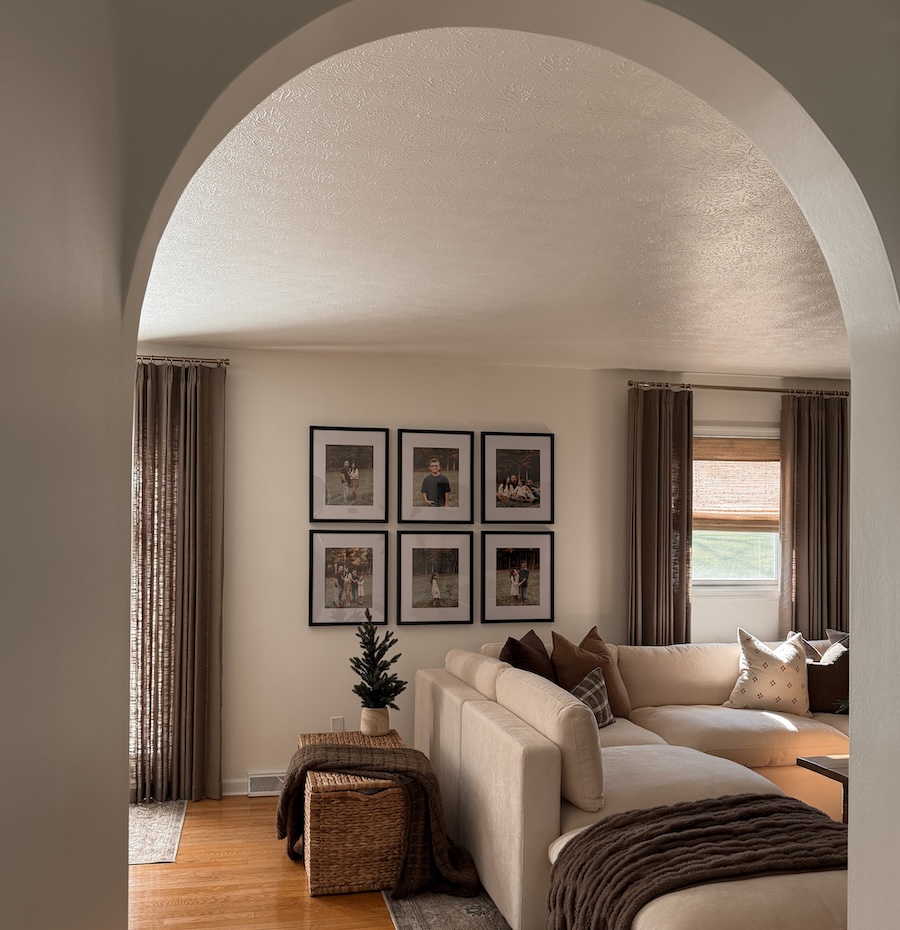
Early direct-to-consumer framing services solved cost and convenience but created new friction. Many shoppers faced confusing customization flows, no way to see the final result, and a gallery wall installation process that felt intimidating. The most capable providers now address these issues with AR preview tools, curated product selections, and ready-to-hang gallery wall systems. Architectural Digest highlighted Frameology’s role in this shift, combining a family framing legacy dating to 1986 with a modern digital experience that feels smooth from upload to installation.
Browse Frameology’s Classic and Luxe frames and start planning your wall.
Evaluation framework for choosing an online framing service
Online framing services vary widely, so a clear framework helps you compare options with confidence.
-
Quality and materials: Archival framing uses acid-free mats, UV-protective glazing, and premium moldings to protect photos for decades. Non-archival options focus on lower upfront cost and may not preserve images as well over time. For irreplaceable pieces or heirlooms, museum-grade materials provide meaningful long-term protection.
-
Ease of ordering: A streamlined service lets you upload a photo, choose a frame, and check out on one intuitive page. Multi-tabbed flows and hundreds of similar options create decision fatigue and often lead to abandoned carts.
-
Visualization tools: Customers who interact with a product in AR are significantly more likely to place an order and less likely to return it. An AR preview that projects a true-to-scale frame onto your wall removes guesswork about size and style. Reviewed.com praised Frameology’s preview feature as a key differentiator among online framing services.
-
Installation complexity: Single frames usually need only a nail and a level. Gallery walls require precise measurement, spacing, and leveling across multiple frames, which can discourage even enthusiastic decorators without the right tools or templates.
-
Turnaround time: Local shops often take one to three weeks. Strong online services ship standard products within a few days. Artisan or museum-quality products may require more time because of their detailed craftsmanship.
-
Pricing transparency: Reliable providers show all-in pricing upfront, including mats, hardware, and shipping, so you are not surprised at checkout.
-
Sustainability: Carbon-neutral shipping and thoughtfully sourced materials now serve as baseline expectations for responsible framing brands.
Market segments and product formats for different spaces
Online framing now covers many formats, and each one fits a different goal, budget, and room type.
-
Framed prints remain the most popular format because they offer classic presentation and strong archival options. Archival choices such as Frameology’s Luxe Wall use acid-free mats, UV-protecting museum-grade acrylic, and continuous-tone archival printing for pieces meant to last generations. The Classic Wall delivers strong value with fast shipping and a removable backing, which suits people who want quality framing and the ability to swap photos.
-
Canvas prints work well when you want a lightweight, frameless look for a large statement piece. Frameology’s Premium Canvas Print uses high-resolution Giclée printing for rich, textured results in sizes up to 40×60, which suits big walls and open spaces.
-
Frameless prints on specialty substrates turn the material itself into part of the design. HD Metal Prints use dye-sublimation infused into scratch-resistant aluminum for vivid contrast and a sleek, modern feel. Glass Prints create a luminous, edge-to-edge floating effect that suits contemporary spaces. Acrylic Block Photos add a compact, gallery-style 3D depth that works well on desks and shelves. Gloss Wood Prints bring organic warmth with a high-gloss finish for cozy or rustic rooms.
-
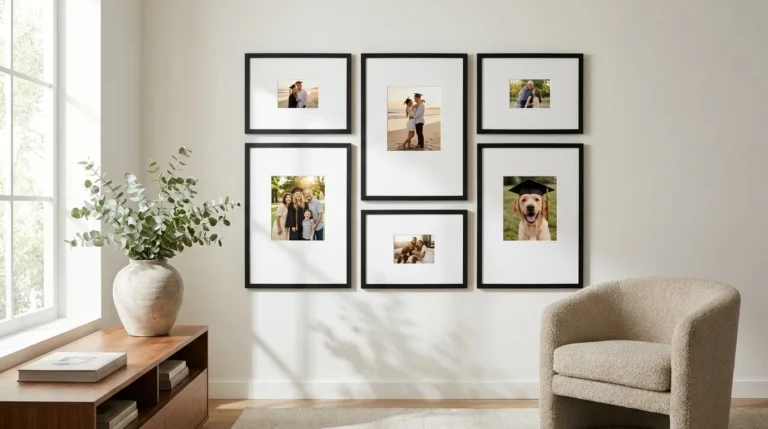
Gallery walls have become a favorite format for creating a focal point, especially in living rooms, staircases, and hallways. Frameology’s Classic gallery walls and Luxe gallery walls both include a custom, life-size gallery wall template for easier installation. Canvas galleries do not include a gallery wall template and suit shoppers who feel comfortable arranging pieces on their own.
Online configurators and mobile AR previews, including Frameology’s tools, help you connect these formats to your actual space. You can design your wall in approximately 10 minutes by choosing a layout, uploading photos, and visualizing it on your wall before you buy.
Key trade-offs and considerations for your framing project
Every framing decision involves a balance between cost, speed, longevity, and flexibility, so knowing what matters most to you makes it easier to choose well.
-
Price vs. longevity: Non-archival framing reduces upfront cost but may leave photos vulnerable to UV damage, acid degradation, or moisture. Archival framing uses acid-free mats, UV-protective glazing, and sealed backings, which suits irreplaceable images, fine art, or heirloom pieces. Frameology’s Luxe line uses museum-quality materials including acid-free matting and UV-protecting museum-grade acrylic, while the Classic line focuses on strong everyday value.
-
Speed vs. customization depth: Classic frames at Frameology typically ship the next business day and arrive within a week. Luxe frames, crafted in the USA with premium solid wood and metal moldings, take 7–10 business days to arrive because of their artisan production. You trade a bit of time for deeper customization and museum-level materials.
-
Decorative impact vs. flexibility: Luxe frames feature a sealed kraft paper backing that protects the photo permanently, so photos cannot be swapped. Classic frames use a removable backing, which works well if you like to refresh displays seasonally or update them as new memories appear.
-
Room type and lighting: High-moisture spaces such as bathrooms favor metal or acrylic substrates instead of paper-based prints. Rooms with strong natural light benefit from UV-protective glazing. Large, open walls suit oversized canvas or multi-frame gallery walls, while smaller rooms often look better with tabletop frames or compact wall arrangements.
Planning your project: image selection, sizing, and layout
Thoughtful planning at the start prevents most framing frustrations later.
-
Wall measurement: Measure the wall space in both width and height before you choose a frame size or gallery wall layout. A single large frame usually looks best when it covers 60–75% of the wall width above a piece of furniture. For gallery walls, map out the total footprint so the arrangement feels balanced.
-
Image resolution: Low-resolution images create blurry prints, especially at larger sizes. As a general rule, aim for at least 150 DPI at the intended print size. Most recent smartphone photos work well for standard frame sizes.
-
Layout approaches: Grid layouts suit formal spaces such as dining rooms and offices. Asymmetric or staircase arrangements feel natural in hallways and living rooms. Frameology offers many pre-designed gallery wall layouts, from the Classic Stack to the Luxe Bricklay, each tailored to specific wall dimensions.
-
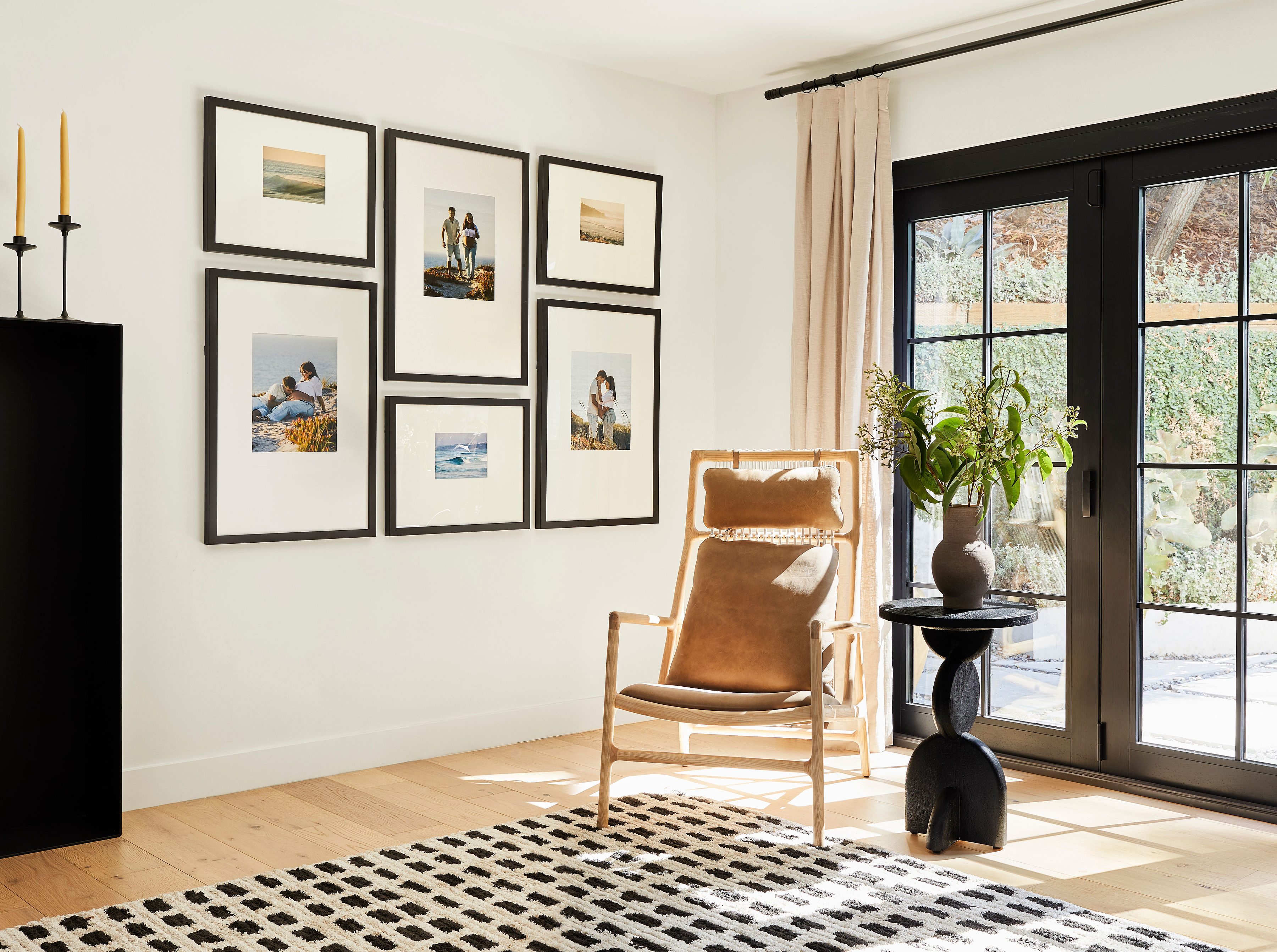
Installation best practices: For single Classic frames, the backing is in one centered spot with the option to hang horizontally or vertically, but you must provide a nail and level. Luxe frames arrive with all hardware included: nails, a mini-level, and a no-wire hanging system with two side hangers for easier leveling. For Classic and Luxe gallery walls, the included gallery wall template simplifies installation: tape it to the wall, mark the nail points, remove the template, then hang the frames. CNN Underscored’s reviewer described the Luxe gallery wall installation as a foolproof process that resulted in perfectly aligned frames.
Readiness checklist before you order
Confirm a few details before you check out so your frames arrive on time and fit your space.
-
Wall dimensions: Measure the available wall space and compare it to the frame or gallery wall dimensions on the product page so the scale feels right.
-
Installation preference: Decide whether you prefer swappable photos with Classic frames or a permanently sealed, museum-quality result with Luxe. Confirm you have a nail and level ready for Classic single frames, or plan to use the included hardware for Luxe frames and all gallery walls.
-
Budget: Start by deciding how much you want to spend. Classic frames begin at $39 for tabletop and $59 for wall, while Luxe frames start at $79. Classic gallery walls start at $198, and Luxe gallery walls start at $638.
-
Timeline: Once you know your budget, check whether your schedule matches the production method you want. Classic products usually ship the next business day and arrive within a week, while Luxe products take 7–10 business days to arrive because of their artisan craftsmanship.
-
Image quality: With budget and timing set, confirm that your photo file has enough resolution for the print size you chose so the final result looks crisp.
-
Visualization: Use Frameology’s mobile AR tool to preview the exact frame on your wall before you place your order.
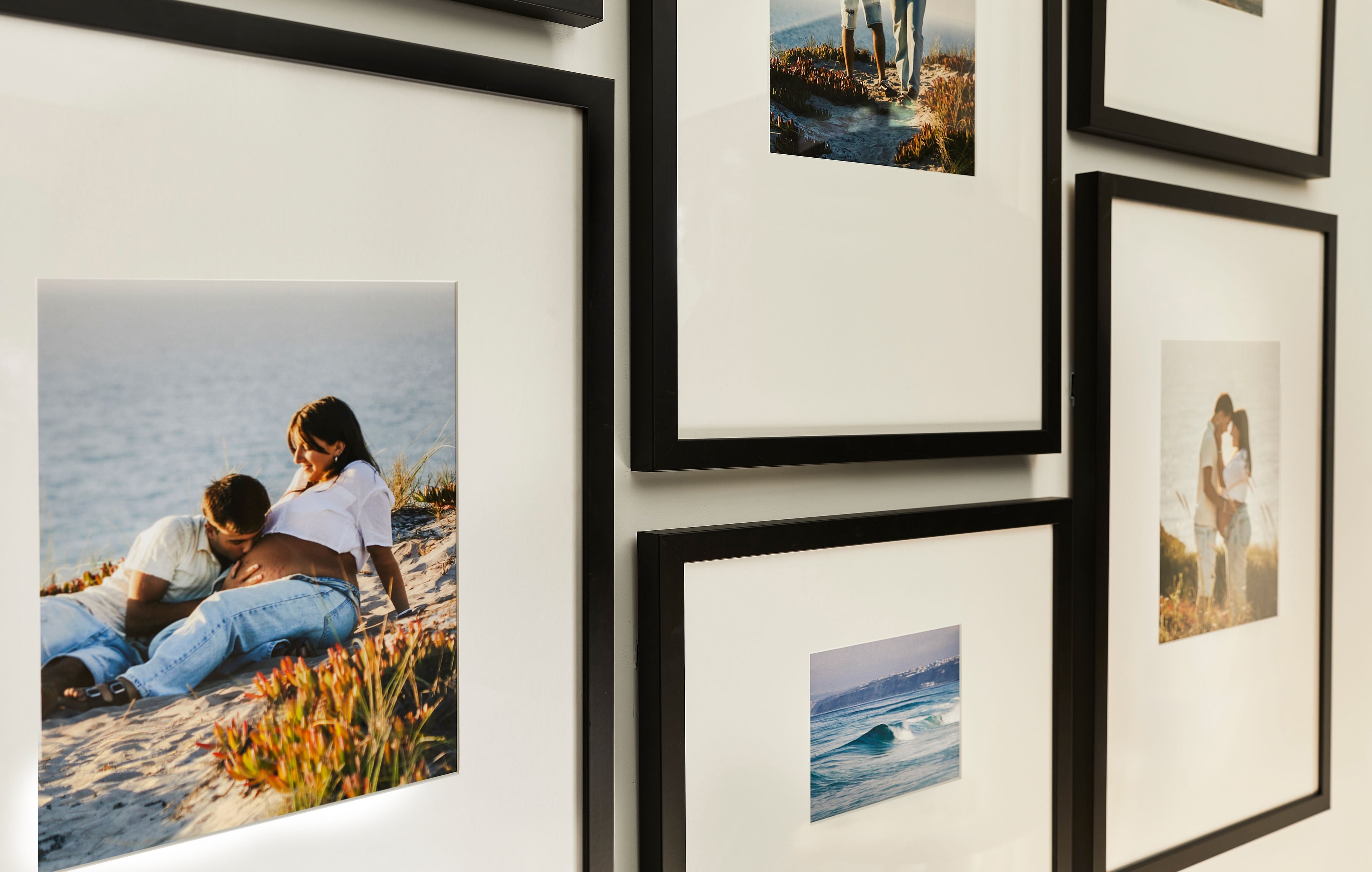
Use Frameology’s AR preview and see your new frame on the wall before you buy.
How to compare online framing providers
A few clear criteria make it easier to compare framing brands side by side.
-
Pricing clarity: Look for all-in pricing on the product page with no surprise fees. Frameology’s Classic Wall frame is priced at $59 for an 8×10 and $75 for an 11×14, with no extra charges for basic options at checkout.
-
Customization options: A strong provider offers a range of frame styles, mat choices, and substrates that cover different aesthetics without overwhelming you with tiny variations.
-
Shipping timelines: Check whether timelines refer to production, shipping, or both. Frameology’s Classic products typically ship the next business day and arrive within a week, while Luxe products take 7–10 business days to arrive because of their artisan craftsmanship.
-
Support and returns: Human, responsive customer support matters when you have questions or something goes wrong. Frameology’s support team helps with both issue resolution and styling advice.
-
Visualization tools: A mobile AR preview that works without an app download now serves as the standard for reducing purchase uncertainty. Frameology’s AR tool lets you upload images, choose frame finishes and mat styles, and preview the result on your wall before you commit.
-
Gallery wall support: For multi-frame projects, templates save time and stress. Frameology’s Classic and Luxe gallery walls both include a custom, life-size gallery wall template.
-
Heritage and quality assurance: Frameology’s roots trace to a family-owned Manhattan frame shop that operated from 1986 to 2020. Frames come from family-run workshops with generations of craftsmanship. Every Luxe frame is 100% made in the USA, and Classic frames are hand-framed in the USA.
Common mistakes and how to avoid them
A few avoidable errors account for most framing disappointments, and knowing them in advance makes the entire process much smoother.
-
Poor image resolution: Uploading a low-resolution file, such as a compressed JPEG, screenshot, or heavily cropped image, often produces a blurry or pixelated print. Always use the original, highest-resolution version of your photo.
-
Mismatched scale: A small frame on a large wall looks lost, while an oversized frame in a narrow hallway can feel overwhelming. Use the AR preview tool to confirm scale and compare product dimensions with your wall measurements.
-
Inaccurate measurements: Measure twice before you order. Many gallery wall issues come from frames sized for a wall that turns out smaller or larger than expected. Check whether dimensions refer to the frame’s outer edge or the image opening.
-
Misunderstanding turnaround times: “Ships in X days” and “arrives in X days” describe different stages. Confirm both production and transit timelines for time-sensitive gifts or events. Frameology’s Classic products usually ship the next business day and arrive within a week, while Luxe products take 7–10 business days to arrive.
-
Choosing the wrong line for the use case: Classic frames suit people who want strong value, quick shipping, and swappable photos. Luxe frames suit shoppers who want museum-quality, permanently sealed, USA-crafted results with all hardware included. Matching the line to your goal prevents disappointment.
-
Skipping the AR preview: Ordering without previewing the frame in your space remains the most avoidable source of regret. Frameology’s mobile AR tool takes less than a minute and removes nearly all guesswork.
Frequently asked questions
What is the difference between Classic and Luxe frames?
Classic frames focus on value and speed. They start at $39 for tabletop and $59 for wall, typically ship the next business day, and feature a removable backing so you can swap photos. A single center hanger is included, but you provide the nail and level.
Luxe frames are Frameology’s museum-quality option. Starting at $79, they are 100% made in the USA from premium solid wood and metal moldings with acid-free mats and UV-protecting museum-grade acrylic. Luxe frames have a sealed kraft paper backing, so photos cannot be swapped, and they arrive with nails, a mini-level, and a no-wire hanging system with two side hangers. Luxe products take 7–10 business days because of their artisan craftsmanship.
What image resolution is needed for a quality print?
A helpful guideline is at least 150 DPI at the intended print size. Most photos taken on a modern smartphone in the last several years meet this threshold for standard frame sizes. For large-format prints such as 20×30 or larger, use the highest-resolution version of the image and avoid compressed files or screenshots. Frameology’s ordering interface flags resolution concerns before you complete your purchase.
How does the AR preview tool work?
Frameology’s AR tool works on mobile devices. Open the Frameology website on your phone, customize your frame, and tap the AR icon. Your camera then projects a true-to-scale preview of the frame onto your wall in real time so you can see how it looks before you buy. You do not need an app download or account login. The AR tool works for both frames and photo gifts.
Do all gallery walls include hanging templates?
Classic and Luxe gallery walls include life-size gallery wall templates that make installation straightforward. Canvas galleries, Metal galleries, and gallery walls created through Frameology’s Gallery Wall Design Service do not include templates because their construction and customization often call for more tailored installation approaches.
How should framed photos be cared for over time?
Keep framed photos away from direct sunlight and high humidity to reduce fading and warping. Luxe frames use UV-protecting museum-grade acrylic that adds a strong layer of protection against light damage. For cleaning, wipe the frame with a soft, dry cloth and avoid liquid cleaners on the glazing. Classic frames with removable backings can be opened to replace photos, while Luxe frames have sealed backings and should stay closed.
Start framing your favorite memories at Frameology
Online custom framing now rivals local frame shops while offering greater convenience, faster turnaround, transparent pricing, and tools that make each step feel manageable. Frameology’s Classic line suits shoppers who want strong value and quick shipping, while the Luxe line suits those who want museum-quality, USA-crafted framing with all hardware included. Both lines are supported by more than 7,300 verified 5-star reviews, a 4.98/5 rating, and carbon-neutral shipping with thoughtfully sourced materials. For a deeper look at what sets Frameology apart from other options, read why Frameology is the best online framing service.
Explore Frameology’s Classic and Luxe collections and create a frame you will love seeing every day.